Why This Matters Now
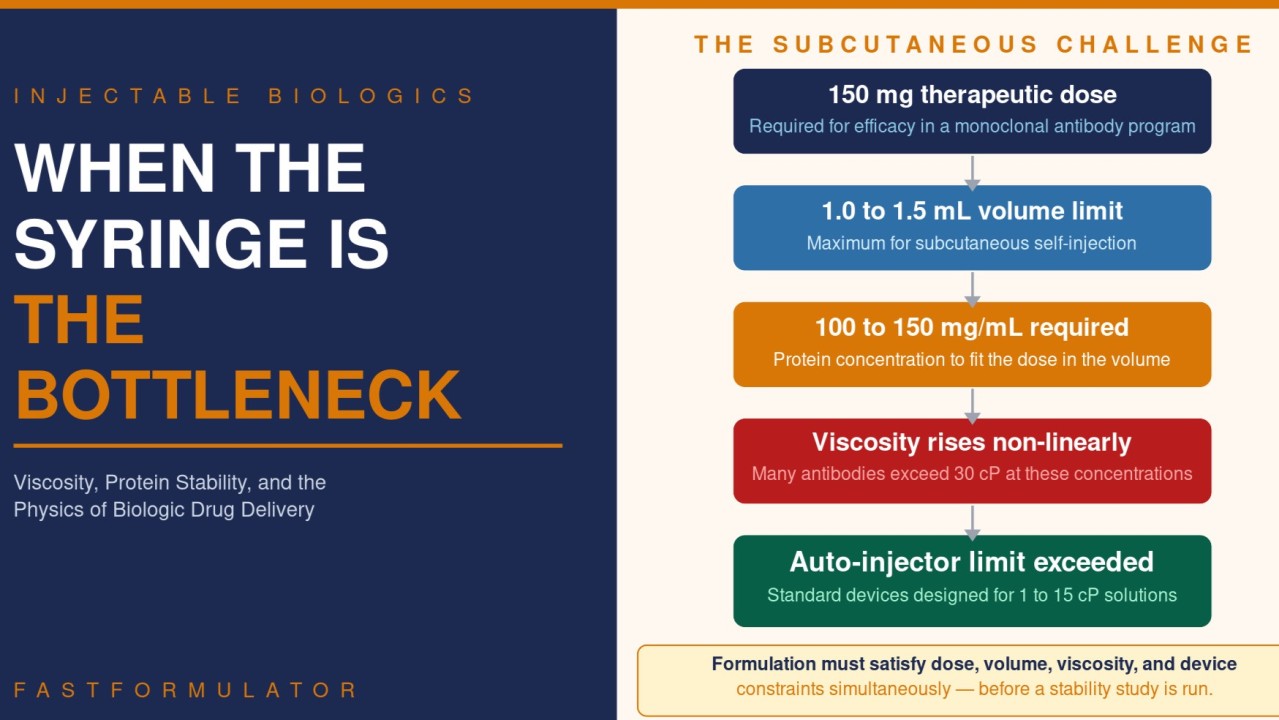
A formulation scientist reviewing Phase II data for a subcutaneous monoclonal antibody faces a constraint that has nothing to do with the drug's pharmacology. The therapeutic candidate demonstrates efficacy at a 150 milligram dose. Delivering that dose subcutaneously, within the volume that a prefilled autoinjector can accommodate and a patient can self-administer, requires a protein concentration above 100 milligrams per milliliter. At that concentration, the measured solution viscosity is 35 centipoise. The autoinjector platform being developed for commercial use is qualified for solutions up to approximately 15 centipoise; beyond that threshold, the spring mechanism cannot deliver the dose within the required injection time without the force exceeding what is considered acceptable for patient-administered devices. The formulation that makes the drug pharmacologically effective makes it physically impossible to inject as intended.
The path from that constraint to a viable product requires either a different device, a different injection approach, or a reformulation that reduces viscosity at the target protein concentration without compromising the protein's conformational stability or its behavior during the storage and shipping conditions the product must survive before it reaches the patient. Each of those options introduces additional variables, and those variables interact with each other in ways that make sequential optimization unreliable as a development strategy.
Injectable biologics present a formulation challenge that is fundamentally different from small-molecule injectables, and the difference is not simply a matter of scale. The molecule itself is a participant in the formulation physics. Its concentration governs viscosity. Its conformational integrity governs aggregation propensity. The excipients that protect it against one failure mode interact with the conditions that drive another. The device that must deliver it imposes tolerances on viscosity and injectability that constrain the formulation space before a single stability experiment is run.
The Biologics Delivery Shift
The pharmaceutical landscape for biologics has changed substantially over the past decade, and the direction of that change has increased rather than decreased the complexity of formulation design.
Monoclonal antibodies, fusion proteins, and related biologic drug classes have become a substantial fraction of the late-stage development pipeline and of approved medicines. The majority of monoclonal antibodies currently approved or in late development require relatively high doses, typically 100 milligrams or more per administration. Intravenous infusion can accommodate dilute solutions of these drugs administered over periods of 30 minutes to several hours, which relaxes viscosity constraints considerably. But intravenous infusion requires clinical infrastructure: access to a healthcare facility, trained staff, and scheduled appointments. For patients requiring chronic therapy, the burden of repeated intravenous visits is substantial, and it has driven sustained commercial and regulatory interest in subcutaneous formulations that patients can self-administer at home using prefilled syringes or autoinjectors.
The subcutaneous route imposes physical limits that intravenous delivery does not. The subcutaneous space tolerates injection volumes of approximately one to one and a half milliliters through conventional devices; large-volume subcutaneous devices can deliver up to two to three milliliters with acceptable tolerability in specialized applications. Delivering a 150 milligram dose in one milliliter requires a protein concentration of 150 milligrams per milliliter. Delivering the same dose in one and a half milliliters requires 100 milligrams per milliliter. In either case, the protein concentration is well above the range in which most antibodies begin to exhibit non-linear viscosity increases, and well above the range for which most autoinjector platforms are originally designed.
The biosimilar market has added another dimension to this challenge. Reference biologics approved for intravenous delivery are increasingly being reformulated for subcutaneous delivery, either by biosimilar developers seeking differentiated market entry or by originators extending product lifecycles. In either case, the formulation team is starting with a protein whose biophysical properties are fixed and working backward to find the formulation conditions that achieve subcutaneous injectability without destabilizing the molecule.
Syringeability: The Physics of Injection
Syringeability refers to the ability of a formulation to be drawn into and expelled from a syringe under the force conditions acceptable for the intended delivery system. For patient-administered subcutaneous injections, this is governed by the relationship between formulation viscosity, needle dimensions, injection volume, and the force or time constraints of the delivery device.
The governing physics follow from the Hagen-Poiseuille relationship for viscous flow through a narrow cylinder: the pressure required to drive a fluid through a needle at a given flow rate is proportional to the viscosity of the fluid and the length of the needle, and inversely proportional to the fourth power of the needle's internal radius. The fourth-power dependence on radius is the critical term. Moving from a 25-gauge needle, with an internal diameter of approximately 0.26 millimeters, to a 27-gauge needle at approximately 0.21 millimeters reduces the internal radius by about 20 percent. That reduction increases flow resistance by a factor of roughly 2.4 at the same flow rate. Moving to a 29-gauge needle, which many patients prefer for comfort during self-injection, increases resistance further still and narrows the formulation viscosity window considerably.
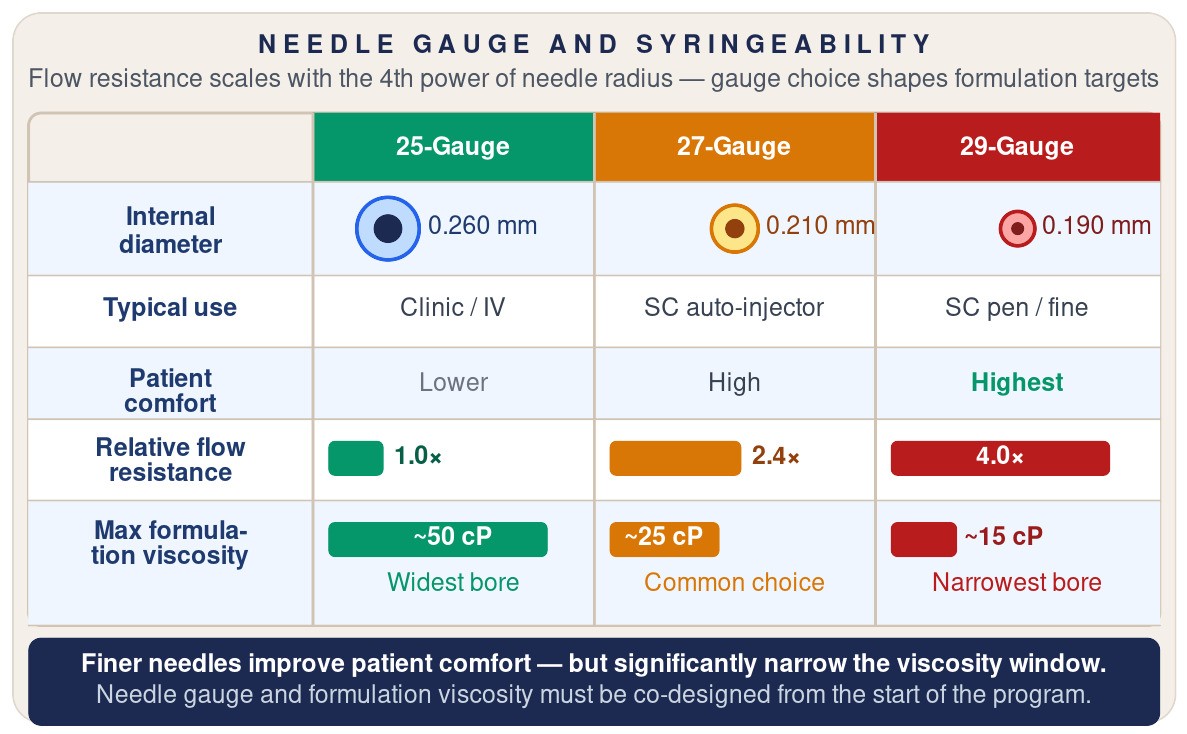
For a low-viscosity small-molecule solution at 1 to 2 centipoise, these differences are manageable within the spring force of standard autoinjector designs. For a high-concentration protein solution at 30 to 50 centipoise, the same needle geometry produces injection forces that may require the patient to apply sustained manual pressure beyond what is ergonomically acceptable, or that exceed the mechanical design limits of the autoinjector mechanism. The practical consequence is that formulation viscosity and device design are not independent choices; they must be developed in relation to each other from the beginning of the program, and changes to either have immediate implications for the other.
Viscosity itself is not a fixed property of a protein solution at a given concentration. High-concentration antibody solutions often exhibit shear-thinning behavior: viscosity decreases as shear rate increases. The viscosity measured at low shear rate in a bench viscometer may differ substantially from the effective viscosity experienced during injection, where shear rates through a fine-gauge needle can be several orders of magnitude higher. This shear-thinning character can be favorable from an injectability standpoint, but it complicates formulation characterization because low-shear measurements do not fully predict in-use behavior. The formulator's task includes characterizing the full shear-rate viscosity profile, not just the single-point measurement that most bench instruments provide.
Protein Stability: The Other Dimension
Protein drugs are susceptible to degradation through multiple pathways, and the relative contribution of each pathway depends on the protein's molecular structure, the composition of the formulation, the manufacturing process, and the conditions the product experiences during storage and delivery.
Aggregation is the degradation pathway of greatest clinical concern for injectable biologics. Protein aggregates ranging from soluble oligomers visible only by analytical methods to subvisible particles detectable by light obscuration to visible particles that can be observed in the container, represent both a loss of drug potency and a potential immunogenic stimulus. Regulatory agencies have emphasized the importance of characterizing and controlling aggregation across the product lifecycle, and the expectation that aggregation be controlled at levels consistent with clinical safety has intensified scrutiny of formulation and manufacturing conditions that contribute to aggregate formation.
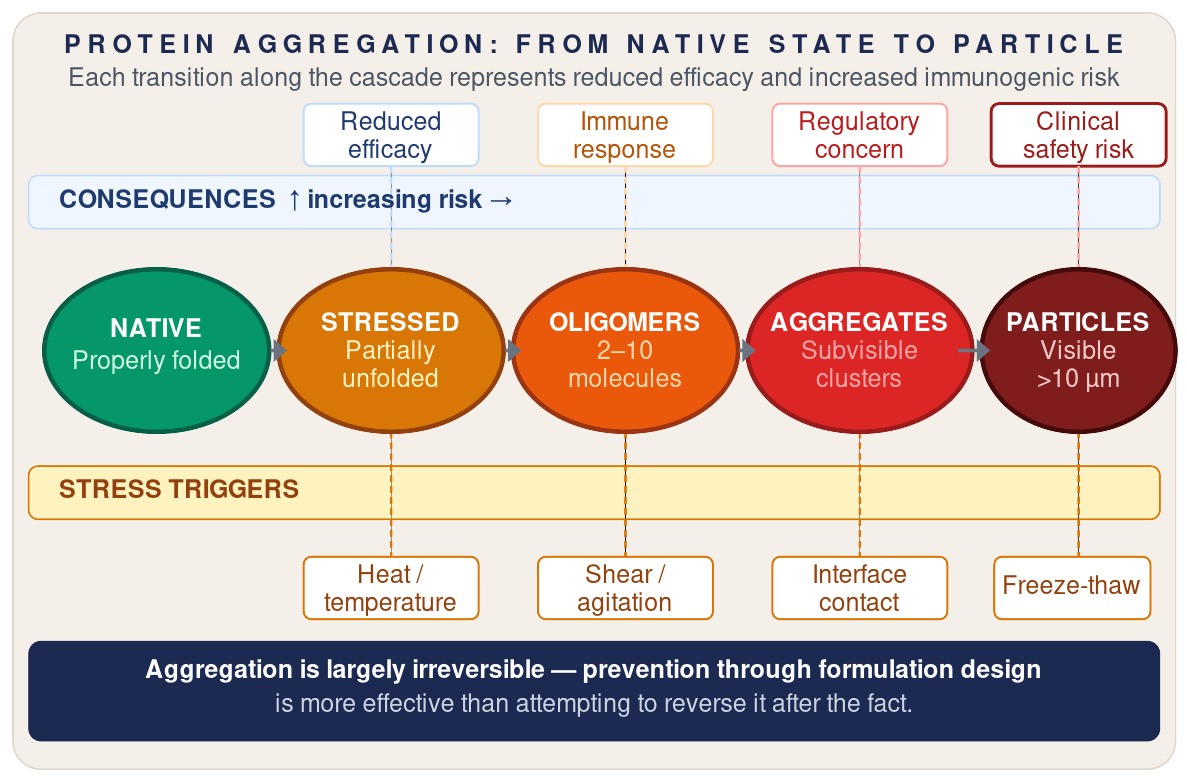
Aggregation is driven by protein-protein interactions that become more frequent as protein concentration increases. Partially unfolded or conformationally altered proteins are more prone to form intermolecular contacts that initiate the aggregation cascade. Thermal stress unfolds proteins and accelerates aggregation; this is why cold chain requirements for biologic products are stringent and why temperature excursions during shipping represent a recognized quality risk. Interfacial stress, particularly at air-water interfaces generated during mixing, filling, and agitation, exposes proteins to conditions that promote surface adsorption and conformational change. Silicone oil from prefilled syringe barrels, rubber components of container closures, and the glass surface of the vial or syringe barrel can all interact with proteins in ways that affect aggregation propensity. Freeze-thaw cycles, relevant for products stored frozen at bulk scale or shipped to markets where cold chain continuity cannot be assured, can concentrate proteins at ice crystal interfaces and generate aggregates that persist in the thawed product.
Formulation design to protect against aggregation draws on excipient classes with distinct mechanisms. Surfactants, most commonly polysorbate 20 or polysorbate 80, compete with proteins for air-water and oil-water interfaces, reducing the rate at which interfacial stress drives aggregation. Polyols and disaccharides, including sucrose and trehalose, interact preferentially with water molecules in a way that stabilizes the protein's native conformation and protects against freeze-thaw stress. Amino acid excipients such as arginine and proline reduce protein-protein interactions through mechanisms involving changes to the solution's dielectric properties and the structure of the hydration shell around the protein. Buffers, including histidine, citrate, and acetate, maintain the pH range within which the protein's net charge distribution favors solubility and discourages self-association. For monoclonal antibodies, pH values in the range of 5.0 to 6.5 are commonly targeted for this reason.
Concentration as the Pivot Point
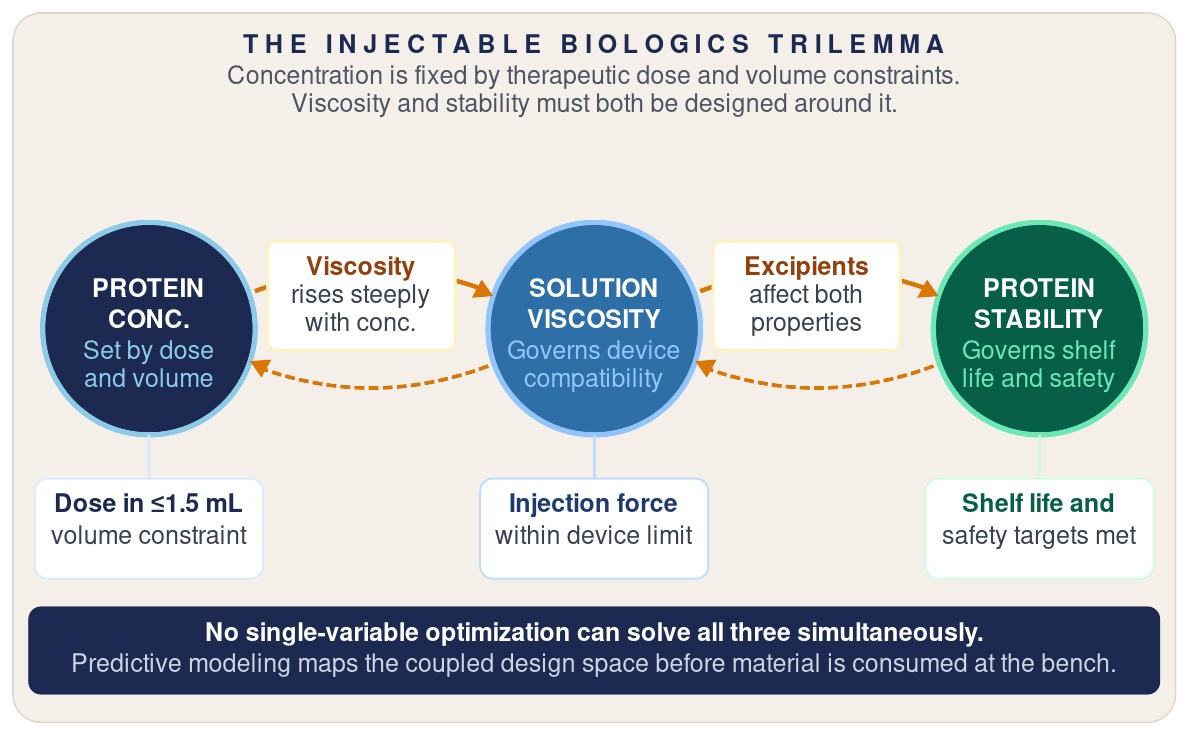
The reason injectable biologic formulation is particularly difficult to optimize by sequential, single-variable approaches is that protein concentration is not a free variable. It is determined by the therapeutic dose and the delivery volume, and both of those are fixed by clinical and device requirements. Everything else in the formulation must be designed around a concentration that the formulator did not choose and cannot change.
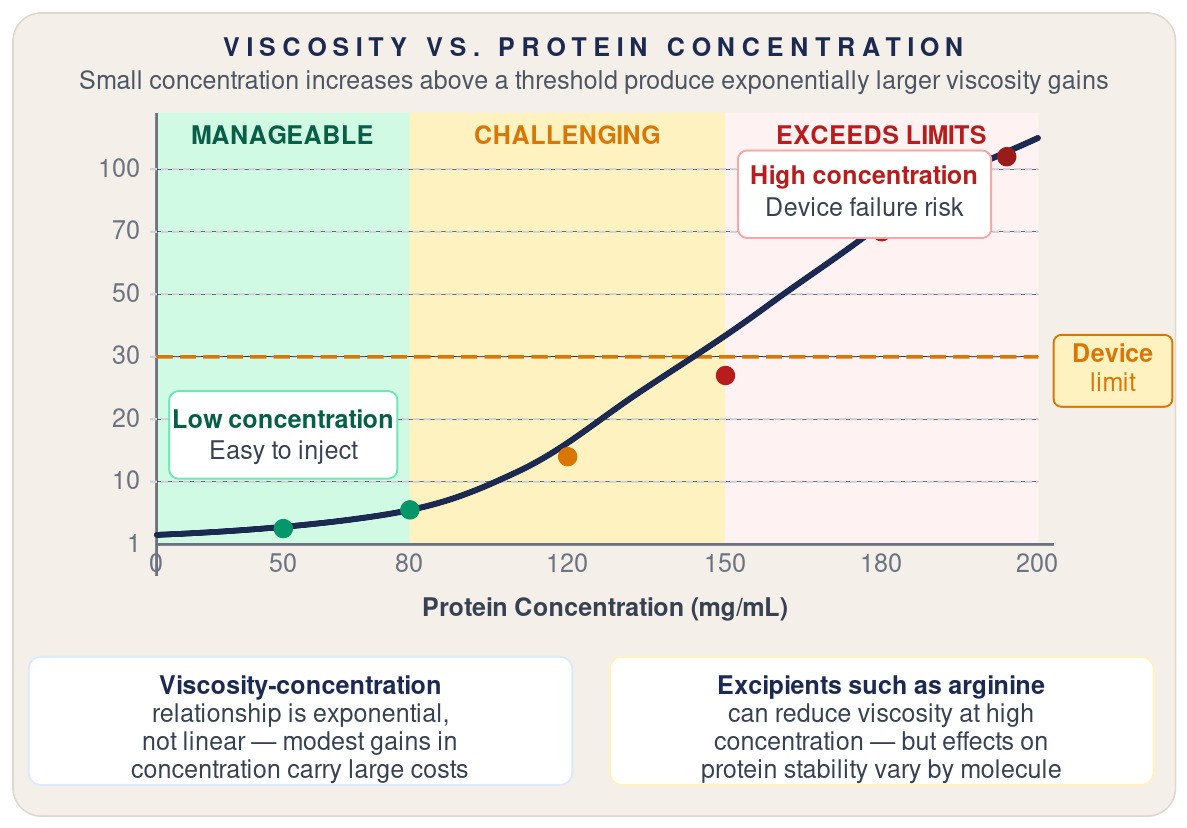
At the concentrations required for subcutaneous delivery of many monoclonal antibodies, viscosity and stability constraints appear simultaneously and pull in opposing directions. High concentration increases viscosity non-linearly; the viscosity of a concentrated antibody solution does not scale proportionally with concentration but rises more steeply, with some antibodies exhibiting viscosities above 100 centipoise at concentrations above 150 milligrams per milliliter. High concentration also increases aggregation propensity by bringing protein molecules into closer proximity, increasing the frequency of intermolecular contacts that initiate aggregation, and reducing the effective free water available to maintain each protein molecule's hydration shell.
The excipients that reduce viscosity at high protein concentration do not act neutrally on stability. Arginine reduces solution viscosity, likely through reduction of protein-protein electrostatic and hydrophobic interactions, but its effect on protein conformational stability and aggregation propensity is protein-specific and not uniformly favorable. Salts can reduce viscosity through charge-screening mechanisms but may accelerate aggregation for some molecules by weakening the electrostatic repulsion that keeps protein molecules separated in solution. Surfactants protect against interfacial aggregation but must be maintained within a concentration window to avoid destabilizing effects at high concentrations. The excipient system that minimizes viscosity and the excipient system that maximizes stability over a two-year refrigerated shelf life are not necessarily the same composition, and treating them as separate optimization targets misses the interactions that determine how the finished formulation actually performs.
Manufacturing operations introduce additional coupling between viscosity and stability. Filtration through membrane filters imposes shear on the protein solution; at high viscosity, the pressures and shear rates required to achieve acceptable filtration rates increase, as does the mechanical stress on the protein. Filling operations for prefilled syringes expose the protein solution to pump-induced shear and to the air-water interface at the fill point. Shipping studies and in-use stability studies subject the formulation to thermal and mechanical stresses whose effect on aggregation is formulation-dependent. None of these stresses is independent of formulation composition, and formulation changes made to address viscosity may shift the protein's response to each of them.
Where Predictive Tools Change the Calculus
The formulation challenge for injectable biologics is characterized by a large design space, multiple coupled constraints, and an experimental cost that scales with protein material availability. At the concentrations required for subcutaneous delivery, producing enough drug substance to support a comprehensive excipient screening program is often the rate-limiting resource constraint in early development. Every formulation condition tested consumes material, and at early development stages, material is produced in quantities that limit how many conditions can be evaluated experimentally before decisions about formulation strategy must be made.
Predictive tools that estimate viscosity from formulation composition and protein concentration offer an earlier decision point. FastFormulator's Virtual Viscometer uses physicochemical models trained on characterized protein-excipient interaction data to estimate how solution viscosity will respond to changes in protein concentration, excipient type, and excipient concentration before material is consumed in bench experiments. For programs where the relationship between concentration and viscosity is the primary bottleneck, this allows formulation teams to screen compositions for injectability computationally, focusing physical testing on the subset of candidates predicted to fall within the device-compatible viscosity window.
FastFormulator's Virtual Stability Chamber extends this capability to protein stability, estimating aggregation propensity under specified storage and stress conditions from formulation composition and relevant protein characteristics. The combination of viscosity and stability prediction within the same computational environment allows formulation teams to evaluate candidate compositions against both constraints simultaneously, identifying the composition space where viscosity and stability requirements overlap before committing to experimental confirmation. For programs where protein material is constrained and the formulation design space spans multiple excipient types and concentration ranges, the ability to narrow the experimental focus before bench work begins changes the resource economics of development meaningfully.
The tools do not replace experimental confirmation. Protein behavior in formulation is influenced by sequence-specific properties that computational models approximate rather than fully capture, and regulatory expectations for injectable biologics require experimental characterization of the final formulation under representative conditions. What predictive tools change is when the first reliable answer about viable composition arrives in the development timeline, and how much material is consumed in reaching it.
Takeaways
The formulation challenge for injectable biologics is defined by a constraint that clinical pharmacology establishes and physics enforces. The protein concentration required to deliver a therapeutic dose through a subcutaneous device within acceptable volume and force constraints determines the viscosity the formulation will exhibit, and that viscosity determines whether the product can be injected at all. Syringeability is not a secondary specification to confirm late in development; it is a primary design variable whose value is set by the intersection of dose, volume, needle geometry, and formulation composition, and whose relationship with protein concentration is non-linear in ways that make it difficult to anticipate from early characterization data alone.
The stability problem adds a coupled constraint rather than a separate one. The formulation conditions that make concentrated protein solutions injectable are not the same as those that maximize long-term conformational stability and control aggregation propensity; the excipients that reduce viscosity interact with the protein in ways that affect stability, and the manufacturing operations that produce the finished product impose stresses that affect both properties simultaneously. For formulation programs where the protein concentration is set by clinical requirements and the device platform is fixed by commercial strategy, the viable formulation space is the region that satisfies viscosity, stability, and device compatibility simultaneously, and finding that region by sequential single-variable experimentation is slow relative to the development timelines that biologic programs face.
Predictive tools that model viscosity and stability from formulation composition offer a way to enter the viable formulation space with fewer experimental iterations. By screening excipient systems and concentration effects computationally before material is committed to bench experiments, development teams can focus physical testing on formulations most likely to satisfy both syringeability and stability requirements at once. For injectable biologic programs where high-concentration formulation development is the rate-limiting technical challenge, the shift in when a reliable answer about viable composition arrives is the difference between development programs that consume material confirming failure and those that spend that material confirming success.
References
- Shire, S.J., Shahrokh, Z. and Liu, J. (2004). Challenges in the development of high protein concentration formulations. Journal of Pharmaceutical Sciences, 93(6), 1390–1402.
- Jezek, J., Rides, M., Derham, B., Moore, J., Cerasoli, E., Simler, R. and Perez-Ramirez, B. (2011). Viscosity of concentrated therapeutic protein compositions. Advanced Drug Delivery Reviews, 63(13), 1107–1117.
- Wang, W. (2005). Protein aggregation and its inhibition in biopharmaceutics. International Journal of Pharmaceutics, 289(1–2), 1–30.
- Ratanji, K.D., Derrick, J.P., Dearman, R.J. and Kimber, I. (2014). Immunogenicity of therapeutic proteins: influence of aggregation. Journal of Immunotoxicology, 11(2), 99–109.
- Falconer, R.J. (2019). Advances in liquid formulations of parenteral therapeutic proteins. Biotechnology Advances, 37(7), 107412.
- Connolly, B.D., Petry, C., Yadav, S., Demeule, B., Krieg, N., Moore, J.M., Shire, S.J. and Gokarn, Y.R. (2012). Weak interactions govern the viscosity of concentrated antibody solutions. Biophysical Journal, 103(1), 69–78.
- Garidel, P., Kuhn, A.B., Schäfer, L.V., Karow-Zwick, A.R. and Blech, M. (2017). High-concentration protein formulations: how high is high? European Journal of Pharmaceutics and Biopharmaceutics, 119, 353–360.
- Bee, J.S., Randolph, T.W., Carpenter, J.F., Bishop, S.M. and Dimitroff, M.W. (2011). Effects of surfaces and leachables on the stability of biopharmaceuticals. Journal of Pharmaceutical Sciences, 100(10), 4158–4170.
- Manning, M.C., Chou, D.K., Murphy, B.M., Payne, R.W. and Katayama, D.S. (2010). Stability of protein pharmaceuticals: an update. Pharmaceutical Research, 27(4), 544–575.
- Yadav, S., Shire, S.J. and Kalonia, D.S. (2010). Factors affecting the viscosity in high concentration solutions of different monoclonal antibodies. Journal of Pharmaceutical Sciences, 99(12), 4812–4829.