Why This Matters Now
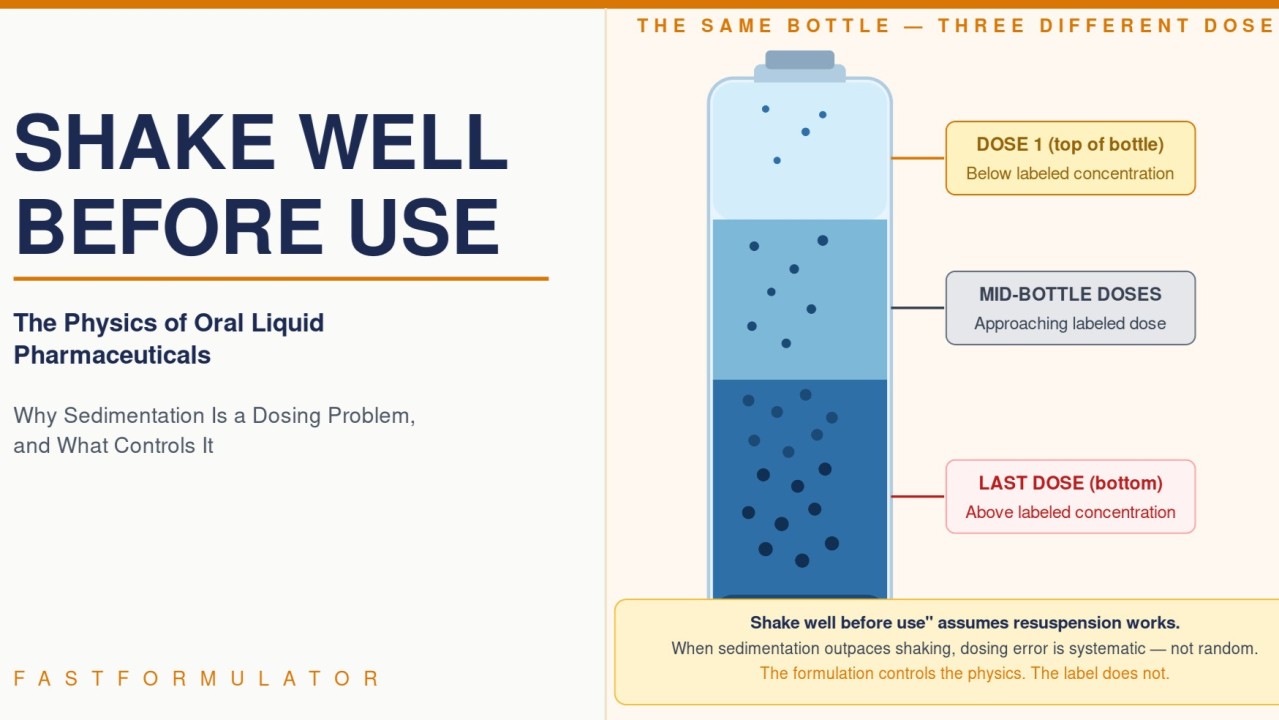
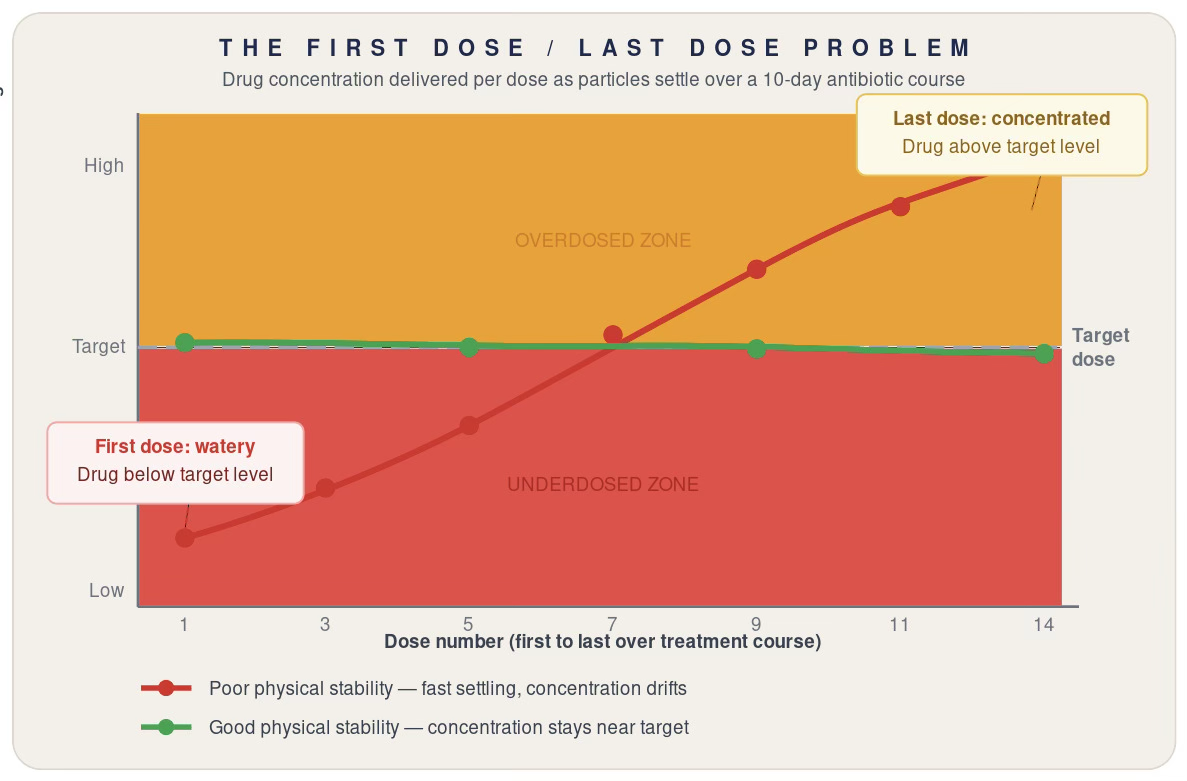
A caregiver measures a tablespoon of amoxicillin suspension for a child with a middle ear infection. The antibiotic was reconstituted at the pharmacy three days ago and has been sitting in the refrigerator since. The first dose poured is noticeably thin. The caregiver shakes the bottle before each subsequent dose, but not vigorously enough to fully resuspend what has settled along the bottom and sides of the container. Over the ten-day course of treatment, the doses delivered at the beginning of the prescription are below the labeled concentration; the doses at the end, drawn from a bottle now dense with settled particles, are above it. The infection partially clears. At the follow-up appointment, the prescribing clinician considers a second course.
This is not an unusual failure mode in pediatric oral liquid therapy. It is a predictable consequence of what happens when the physical stability of a suspension dosage form is not adequately matched to the realities of how patients and caregivers actually use it. The instruction printed on the label, "shake well before use," is the pharmaceutical industry's most widely deployed acknowledgment that the formulation inside the bottle will separate during storage. For products where the degree of separation is small and resuspension is easy, this instruction is sufficient. For products where particles settle quickly, where sedimentation compacts into a layer that resists casual shaking, or where the dose volume is small enough that even a modest variation in particle concentration produces a clinically significant difference in the amount of drug delivered, it is not.
Oral liquid pharmaceuticals occupy a challenging position in the formulation landscape because the same properties that make a suspension physically stable enough to survive distribution and storage often work against the dose accuracy and patient usability that determine whether a treatment actually succeeds in practice. Understanding why requires examining what drives sedimentation in a liquid suspension, what distinguishes a resuspendable sediment from one that becomes permanently compacted, and how the formulation variables that control these properties interact with each other and with requirements for pourability, palatability, and microbiological safety.
The Pressures Reshaping Oral Liquid Formulation
Several forces are restructuring the development environment for oral liquid pharmaceuticals, and they converge on the same basic challenge of delivering an accurate drug dose from a physically heterogeneous dosage form.
Pediatric formulation requirements have become more rigorous over the past two decades. In the United States, the Pediatric Research Equity Act requires that sponsors of new drug applications assess safety and efficacy in pediatric populations for drugs likely to have pediatric use. In the European Union, the Pediatric Regulation similarly requires pediatric investigation plans for most new medicines. These requirements have driven development of pediatric-specific formulations for drugs previously available only as adult tablets or capsules, and oral liquids are the most practical dosage form for young children who cannot swallow solid dosage forms reliably. The commercial result has been an expanding portfolio of pediatric liquid formulations that must meet regulatory standards for dose uniformity across the shelf life, not merely at the point of manufacture.
Antibiotic stewardship has elevated the stakes for dosing accuracy in oral suspensions specifically. Amoxicillin and amoxicillin-clavulanate suspensions are among the most frequently prescribed pediatric antibiotics globally, and the clinical consequence of underdosing is not limited to treatment failure. Subtherapeutic antibiotic concentrations are a driver of resistance selection, and formulations that deliver inconsistent concentrations across a course of therapy contribute to this problem at the individual patient level. The relationship between suspension physical stability and antibiotic stewardship outcomes makes the formulation science less abstract than it might otherwise appear.
Ingredient and manufacturing pressures add further complexity. Several suspending agents and co-solvents commonly used in oral liquid formulations face scrutiny on safety grounds in pediatric populations; sorbitol at high doses causes osmotic diarrhea, propylene glycol carries toxicity concerns for neonates, and certain artificial sweeteners have generated regulatory attention in pediatric applications. Reformulating a suspension to reduce or replace a problematic excipient changes the viscosity of the continuous phase, which alters the sedimentation behavior of the particles, which changes how quickly the product separates during storage and how easily it resuspends before dosing.
The Physics of Settling
The rate at which a particle settles through a liquid is described, for dilute systems under laminar flow conditions, by Stokes' Law. The settling velocity is proportional to the square of the particle radius, to the difference in density between the particle and the surrounding liquid, and to gravitational acceleration, and it is inversely proportional to the viscosity of the continuous phase. Each of these relationships has direct practical implications for suspension formulation.
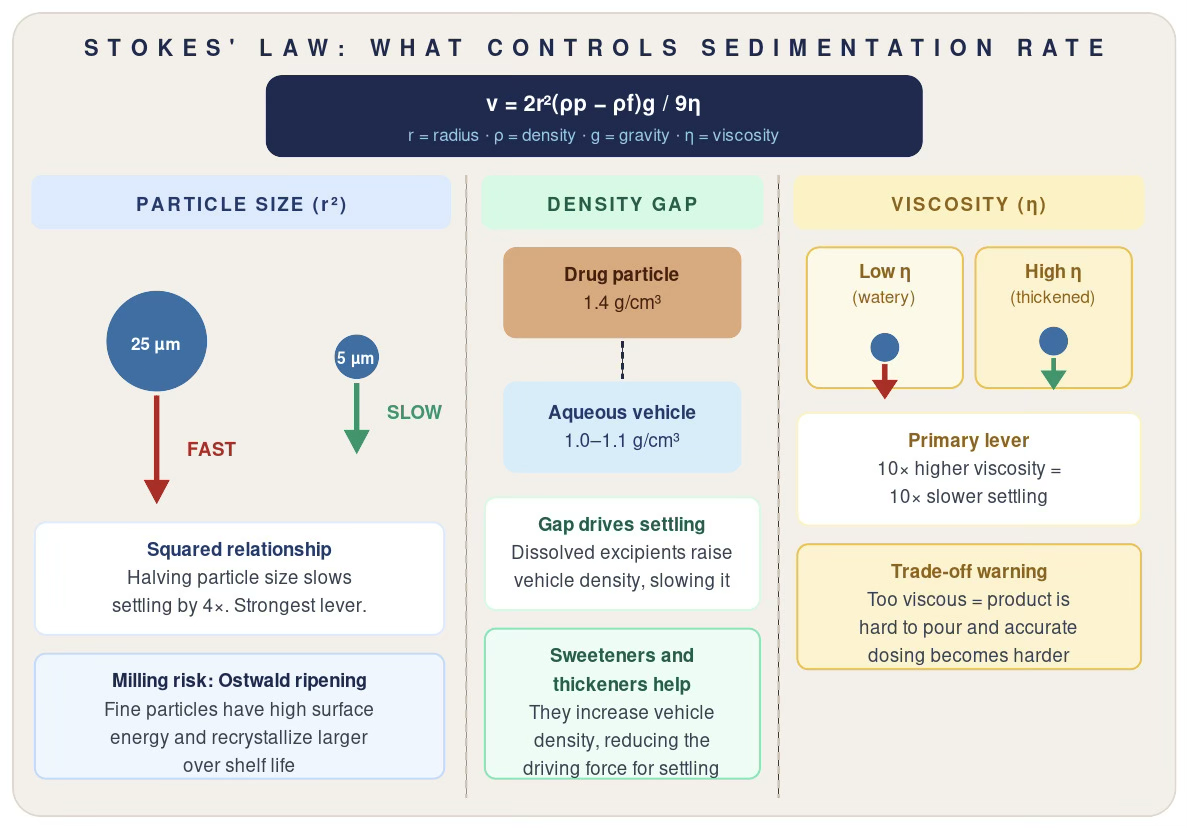
Particle size has the strongest influence on settling rate because the relationship is squared: halving the mean particle diameter reduces the settling velocity by a factor of four. This is why particle size reduction through milling is one of the primary physical stability tools available to the formulator. A drug substance milled to 5 microns settles twenty-five times more slowly than the same drug at 25 microns, all else being equal. The practical limit to particle size reduction depends on the milling process, the mechanical properties of the drug substance, and the tendency of very small particles to aggregate and form secondary agglomerates that behave as much larger particles in the suspension. Micronized particles also have substantially higher surface energy than larger particles, which creates a thermodynamic driving force for crystal growth during storage: particles dissolve and recrystallize onto larger crystals in a process called Ostwald ripening, gradually increasing the mean particle size and accelerating sedimentation over the product's shelf life.
Density difference, the gap between the density of the suspended particle and the density of the continuous phase, is less directly controllable than particle size but influences both settling rate and the direction of displacement. Most pharmaceutical drug substances are denser than aqueous continuous phases, so particles settle downward; a drug substance with a density of 1.4 grams per cubic centimeter settling through water at 1.0 grams per cubic centimeter has a density difference of 0.4. Adding dissolved solutes to the continuous phase increases its density, reducing the density difference and slowing settling. Suspending agents and sweeteners both contribute to continuous phase density. This interaction between excipient choice and sedimentation physics creates a practical constraint: the continuous phase density cannot be adjusted independently of its effects on viscosity, osmolarity, and palatability
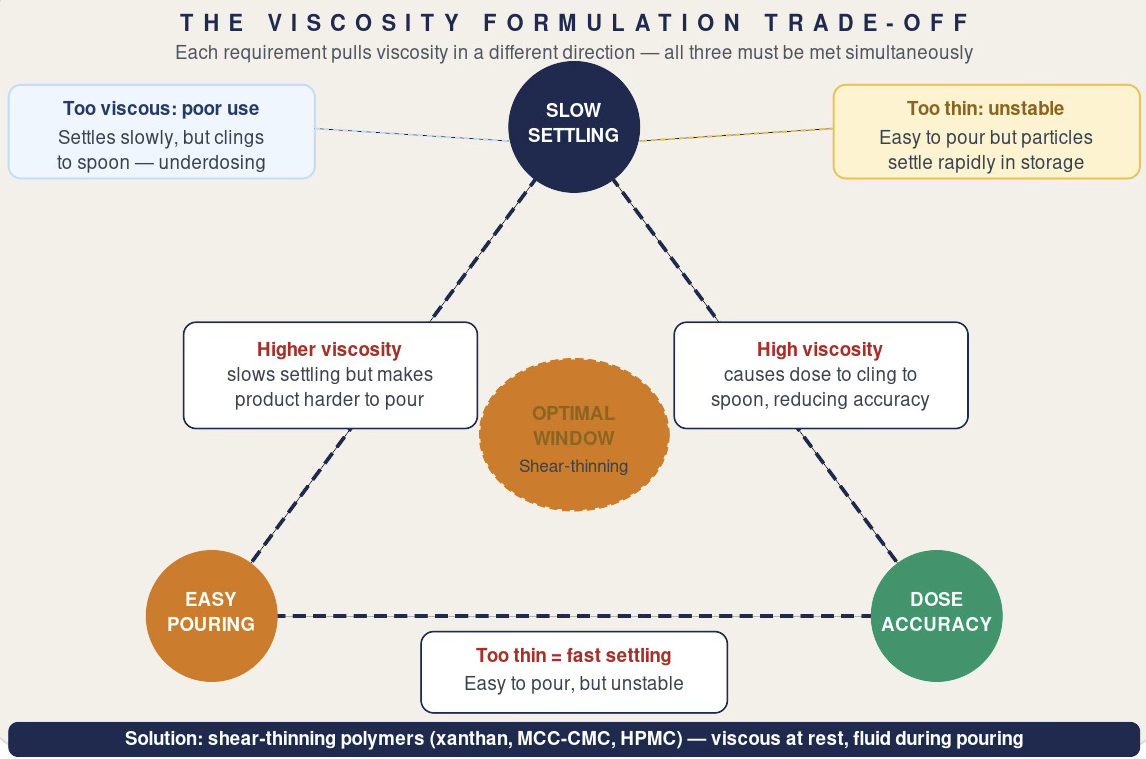
Continuous phase viscosity is the primary controllable lever for managing settling rate after particle size and density are fixed. A continuous phase that is ten times more viscous than water reduces the settling velocity of any given particle by a factor of ten. Polymeric thickeners, including xanthan gum, microcrystalline cellulose in combination with carboxymethylcellulose, and hydroxypropyl methylcellulose, are the workhorses of suspension viscosity control. Most of these materials produce solutions that are shear-thinning: the apparent viscosity is high at low shear rates, which is the condition during storage when particles are settling, and lower at high shear rates, which is the condition during shaking, pouring, and swallowing. This behavior is desirable in principle; the high viscosity at rest slows settling, while the low viscosity during use makes the product easy to pour and palatable. In practice, designing the viscosity profile to satisfy both requirements simultaneously, and to maintain that profile through temperature cycling and the duration of the labeled shelf life, is a less straightforward problem than choosing a thickener concentration from a preliminary study.
Resuspendability: What Happens After Settling
The degree to which a suspension sediments during storage is a separate consideration from how easily that sediment can be resuspended by the patient or caregiver. A product that settles readily may still be safe and dose-accurate if the sediment disperses uniformly with a brief shake. A product that settles slowly but forms a compacted cake that resists mechanical resuspension is more dangerous precisely because the gradual, less visible nature of its sedimentation may not prompt vigorous shaking, and because no realistic amount of shaking will fully redisperse the compacted layer.
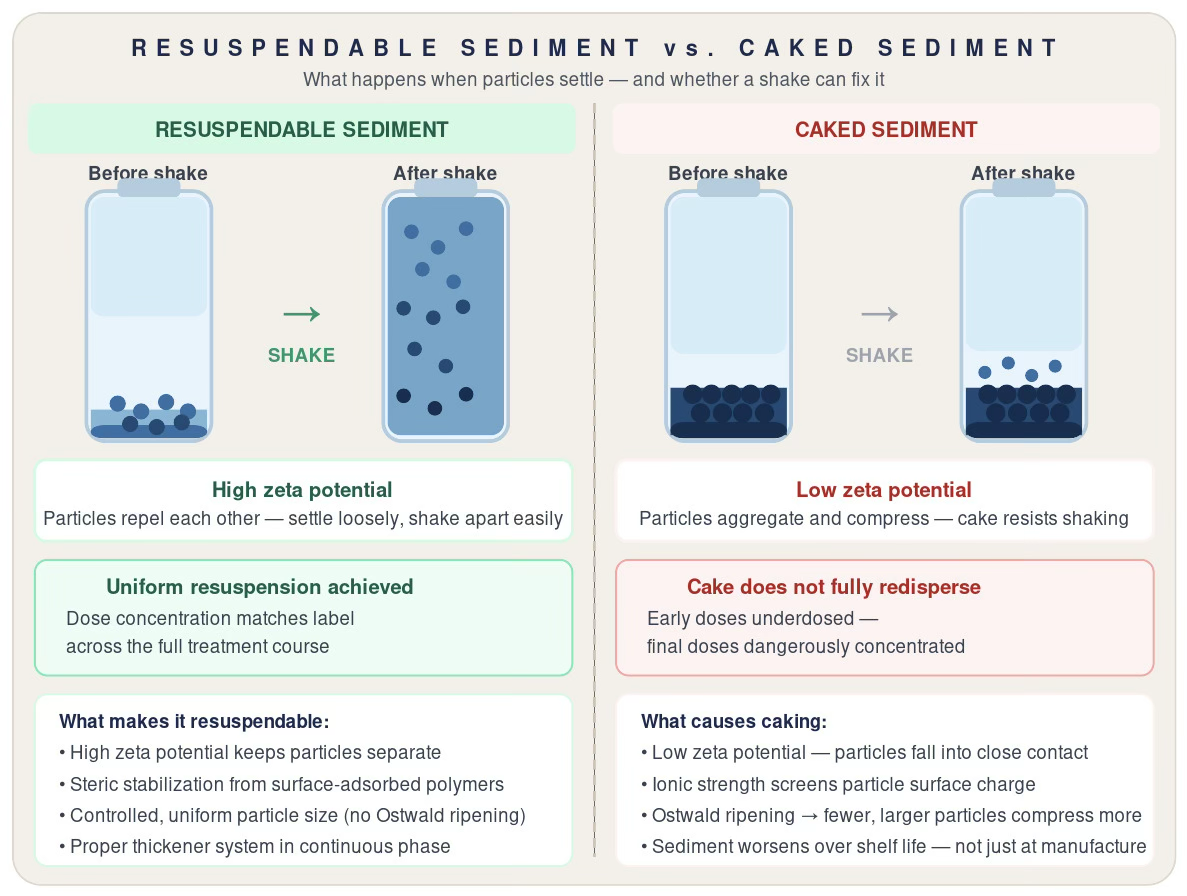
The distinction between a resuspendable sediment and a caked sediment is determined by the interparticle forces that develop as particles accumulate at the bottom of the container. Particles approaching each other experience van der Waals attraction at short range, and if they carry surface charge, electrostatic repulsion at longer range. Particles with high zeta potential, a measure of the magnitude of this electrostatic repulsion, resist close approach and settle into a loosely packed arrangement that is easily disrupted by mechanical agitation. Particles with low zeta potential, or particles whose surface charge is screened by dissolved electrolytes in the continuous phase, are able to approach close enough to fall into the attractive primary energy minimum: they aggregate, and the aggregated structure consolidates under the weight of settling particles above it. Once consolidated, the compacted layer cannot be redispersed without applying more mechanical energy than a caregiver is likely to generate by shaking a bottle.
Crystal growth during storage worsens this problem. As the mean particle size increases through Ostwald ripening, the number of discrete particles decreases and the void space between settled particles collapses further. A sediment that was loosely packed and easily resuspendable at the time of manufacture may become difficult or impossible to redisperse after six months of storage. This time-dependence of resuspendability means that physical stability studies at early time points can underestimate the severity of the problem that emerges at the end of shelf life.
Steric stabilization, in which polymer chains attached to or adsorbed onto particle surfaces create a physical barrier against close approach, provides an alternative to electrostatic stabilization that is less sensitive to ionic strength. Nonionic surfactants and certain hydrocolloids can adsorb onto particle surfaces and provide steric repulsion. The trade-off is that these materials also affect the viscosity of the continuous phase and, in some cases, the interaction of the drug with the gastrointestinal mucosa during absorption.
Viscosity as a Dosing Accuracy Variable
The viscosity of an oral liquid formulation affects dose delivery in ways that are distinct from its role in controlling sedimentation. A product that is too viscous to pour freely retains a significant fraction of its volume clinging to the inside of the measuring spoon or cup after the dose is transferred, effectively reducing the dose delivered. A product that is too thin may be difficult to measure accurately because small variations in technique produce proportionally large errors in the volume dispensed. For pediatric patients dosed by weight, where the labeled dose may be as small as 2.5 milliliters, these measurement errors are not trivial.
The measuring tools available in a consumer setting add to the challenge. Unit-dose oral syringes, which draw product from the bottle and deliver it directly to the child's mouth, are more accurate than measuring cups but require the formulation to be fluid enough to fill the syringe barrel reliably. Measuring cups, which are more commonly included with over-the-counter pediatric products, introduce errors related to meniscus reading, surface tension effects, and residual product adhering to the cup walls after the dose is administered. The optimal viscosity range for accurate dosing in a consumer setting is a design specification that most formulation programs address through sensory evaluation and usability testing, but the relationship between the bulk viscosity measurement and the actual dose delivered under realistic use conditions is not always direct.
Shear-thinning behavior is relevant here because the apparent viscosity during pouring, which occurs at relatively high shear rates, is substantially lower than the apparent viscosity at rest. A formulation that appears adequately viscous when measured at low shear in a laboratory rheometer may pour like water during consumer use. Viscosity characterization for oral liquid development should include measurements across the shear rate range relevant to the use conditions, not only at standardized low-shear conditions.
Oral Solutions: A Different Stability Problem
Oral solutions, in which the drug substance is fully dissolved rather than suspended, present a different set of stability challenges. Physical sedimentation is not relevant because there are no particles to settle, but the absence of this problem does not make solution formulations simpler; it replaces the physical stability concern with a chemical stability concern that is at least as difficult to manage.
A drug in solution is more directly exposed to the chemical environment of the formulation than a drug in a solid crystal lattice. Hydrolysis, oxidation, and photodegradation all proceed more rapidly in aqueous solution than in solid state, and the rate of these reactions depends on pH, the concentration of dissolved oxygen, the presence of metal ion impurities, light exposure, and temperature in ways that interact with the other formulation variables. Managing chemical stability in an oral solution requires selecting buffering agents and antioxidants that do not interact with the drug, adjusting pH to the range of maximum stability without impairing palatability, and sometimes using nitrogen purging during manufacture to minimize dissolved oxygen content.
Co-solvents such as glycerin, sorbitol, and polyethylene glycol improve drug solubility in aqueous vehicles and reduce the likelihood of precipitation during storage, but they introduce osmolarity and palatability considerations. Highly concentrated co-solvent systems may cause osmotic diarrhea, particularly in pediatric populations where the dose volume relative to body weight is higher than in adults. Microbiological safety requires the selection and optimization of a preservative system that is effective across the full range of pH and co-solvent conditions in the formulation, and that remains effective through the product's shelf life as preservative concentration may decline through interaction with packaging materials or through chemical degradation.
Why These Variables Cannot Be Adjusted Independently
The coupling between particle size, continuous phase viscosity, density, chemical stability, and consumer usability makes oral liquid pharmaceutical development resistant to sequential, one-variable-at-a-time approaches. Reducing mean particle size to slow sedimentation may increase surface area enough to accelerate chemical degradation of the drug substance. Increasing thickener concentration to raise continuous phase viscosity slows settling but may reduce pourability and impair dose accuracy in a consumer setting. Selecting a buffering system to optimize pH for chemical stability may alter the surface charge on the drug particles, changing the zeta potential and shifting the resuspendability behavior of the sediment. Substituting a high-sorbitol sweetener system to improve palatability increases continuous phase density, which reduces the driving force for sedimentation but may also raise osmolarity to levels that cause gastrointestinal effects in young children.
The reformulation scenario in which a problematic excipient must be replaced without disrupting physical stability or dose accuracy is where these couplings become most visible. Replacing a suspending agent requires re-optimizing viscosity, which requires reassessing settling rate under the new continuous phase conditions, which requires re-examining whether the existing preservative system remains effective at the new thickener concentration, which requires stability studies under multiple formulation variations simultaneously. The number of interdependent experiments required to identify a stable, dose-accurate, and palatable reformulation is substantially larger than the number required to address any single variable in isolation.
Where Predictive Tools Change the Approach
Traditional oral liquid development follows a cycle of formulate, characterize, and age. A candidate suspension is prepared, its initial viscosity, particle size distribution, and sedimentation behavior are characterized, and the product is placed on stability to observe what happens over time. For programs where the design space is well-understood and the formulation variables are familiar, this approach works within a reasonable timeline. For reformulation programs where multiple excipients are changing simultaneously, where sedimentation and resuspendability are difficult to predict from initial characterization, or where a shelf-life stability study representing months of real time must be repeated for each formulation variant, the cycle becomes slow and expensive in proportion to the complexity of the problem.
Predictive modeling tools that estimate physical stability from formulation composition offer a different kind of early insight. Rather than discovering how a suspension will behave by aging it, these tools use chemistry-aware models to estimate how particle size, density, and continuous phase viscosity will interact to produce a sedimentation rate and a sediment structure for a given formulation, before any material is committed to a stability study. FastFormulator's Virtual Stability Chamber uses this kind of model to provide early estimates of sedimentation behavior and physical stability risk for suspension formulations, allowing development teams to screen formulation candidates computationally before selecting the most promising candidates for experimental characterization and accelerated aging. The Virtual Viscometer complements this by predicting how the rheological profile of the continuous phase responds to changes in thickener concentration or excipient composition, helping teams identify the viscosity window that satisfies simultaneous requirements for sedimentation control and dose delivery accuracy without requiring a complete set of rheological measurements for every candidate.
For oral liquid pharmaceutical development, where the timeline for recognizing a physical stability problem through conventional aging studies may not leave sufficient time to reformulate within the development plan, these tools shift the earliest decision point in the process from after physical testing to before it.
Takeaways
Oral liquid pharmaceuticals are held to a dosing accuracy standard that most formulation programs do not fully internalize during development. The labeled concentration printed on the bottle is a statement about the product at the time of manufacture; whether that concentration is delivered at the time of use depends on whether the physical stability of the formulation is sufficient to maintain uniform particle distribution through storage, distribution, and patient handling. When it is not, the dosing error is not random noise: it is systematic, progressive, and predictable from the physics of how particles settle through a viscous medium. For pediatric patients, where therapeutic windows are narrow and dosing is weight-based, the clinical consequence of this systematic error is not a statistical abstraction.
The difficulty in developing an oral liquid suspension that meets these standards is not in understanding any of the individual governing properties. Stokes' Law is not a new concept, and the relationship between particle size, continuous phase viscosity, and settling rate is well-established. The difficulty is in the tight coupling between all of the variables that must be controlled simultaneously: particle size and its effects on surface energy and Ostwald ripening, continuous phase viscosity and its effects on pourability and dose measurement accuracy, excipient selection and its effects on chemical stability and palatability, and the time-dependence of sediment structure that makes early stability measurements a poor predictor of shelf-life performance. Addressing one of these variables rarely improves the others, and frequently moves them further out of specification.
Predictive tools built on physicochemical models of suspension behavior can change the economics of this development process by providing early estimates of sedimentation rate and physical stability risk from formulation composition before experimental resources are committed. By identifying which combinations of particle size, thickener, and excipient concentrations are most likely to produce a suspension that remains dose-accurate and easily resuspendable across the labeled shelf life, these tools allow development teams to concentrate their experimental work on the candidates with the highest probability of meeting the specification, rather than distributing limited stability chambers and development time across the full combinatorial space. The result is a more directed path from formulation concept to a pediatric oral liquid that delivers what its label promises, to the patients who cannot speak for themselves when it does not.
References
- Stokes, G.G. (1851). On the effect of the internal friction of fluids on the motion of pendulums. Transactions of the Cambridge Philosophical Society, 9, 8–106.
- Florence, A.T. and Attwood, D. (2016). Physicochemical Principles of Pharmacy, 6th Edition. Pharmaceutical Press, London.
- Bhatt, R.L. and Bhatt, S. (2013). Pediatric oral drug products: formulation considerations. In: Oral Drug Absorption: Prediction and Assessment, 2nd Edition. CRC Press, Boca Raton, FL.
- U.S. Food and Drug Administration (2003). Guidance for Industry: Pediatric Research Equity Act. FDA, Rockville, MD.
- Tadros, T.F. (2012). Dispersion of Powders in Liquids and Stabilization of Suspensions. Wiley-VCH, Weinheim.
- Becker, L.C., Bergfeld, W.F., Belsito, D.V. et al. (2019). Safety assessment of sorbitol and related ingredients as used in cosmetics. International Journal of Toxicology, 38(Suppl 2), 5S–22S.
- Allen, L.V. and Erickson, M.A. (1996). Stability of baclofen, captopril, diltiazem hydrochloride, dipyridamole, and flecainide acetate in extemporaneously compounded oral liquids. American Journal of Health-System Pharmacy, 53(18), 2179–2184.
- Pifferi, G. and Restani, P. (2003). The safety of pharmaceutical excipients. Farmaco, 58(8), 541–550.
- Müller, R.H., Jacobs, C. and Kayser, O. (2001). Nanosuspensions as particulate drug formulations in therapy: rationale for development and what we can expect for the future. Advanced Drug Delivery Reviews, 47(1), 3–19.
- WHO Expert Committee on the Selection and Use of Essential Medicines (2023). The Selection and Use of Essential Medicines: Report of the WHO Expert Committee. WHO Technical Report Series, Geneva.